
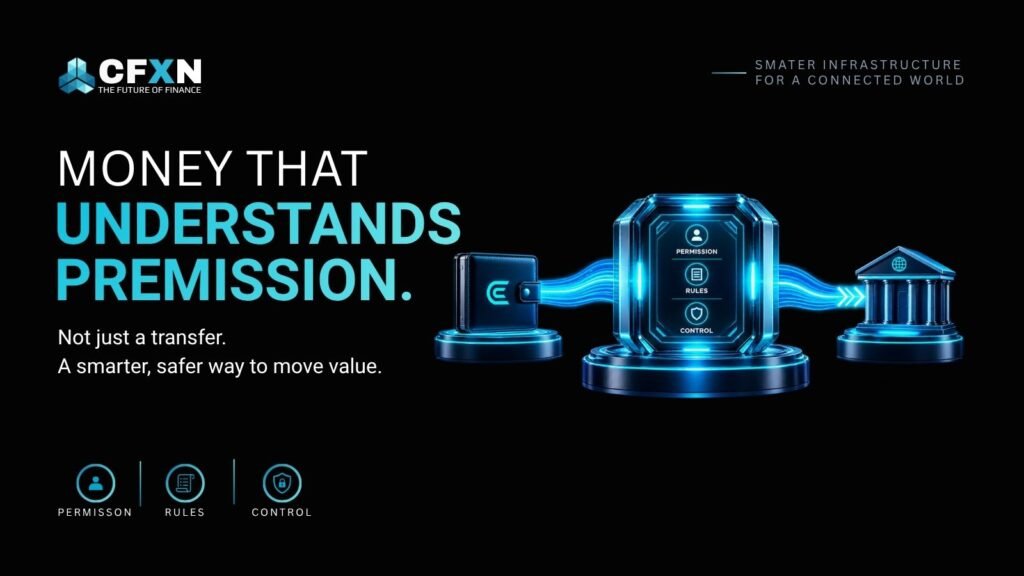
For most of financial history, money has waited for instructions.
A person walks into a bank.
A person signs a form.
A person approves a payment.
A person checks the balance.
The machine does what it is told.
That arrangement is beginning to look rather old.
Artificial intelligence is starting to act inside applications. Payment networks are experimenting with transactions initiated by software. Stablecoins are moving deeper into mainstream financial infrastructure. Banks are exploring digital assets instead of merely watching them from the sidelines.
The interesting question is no longer whether software can move money.
It can.
The interesting question is whether we can teach it when it should move money, how much it should move, and when it should stop.
That is where the next financial story gets serious.
And for CFXN, it creates a particularly interesting opportunity.

The payment is becoming a small part of a much bigger experience
Imagine ordering something online.
You do not want to become involved in the payment machinery.
You want the product.
The seller wants the order.
The supplier wants to get paid.
The software wants to complete the transaction.
The payment is simply the bridge connecting all four.
That sounds obvious.
It is actually a major shift in how financial technology should be designed.
Visa says more than 160 stablecoin linked card programs are now live around the world. It reports that payment volume on those programs has grown nearly 200 percent year over year, while stablecoin settlement has reached a more than 20 billion dollar annualised run rate. (Visa)
Those numbers do not tell us which company will win.
They tell us something more useful.
The infrastructure underneath digital payments is becoming commercially important.
And once infrastructure becomes valuable, the battle moves deeper.
The question becomes who can make different systems work together without making the customer think about the machinery.

Speed was yesterday’s bragging right
There was a time when faster meant better.
Then everyone became fast.
Now speed is becoming the entry ticket.
The next advantage may be control.
Imagine giving an artificial intelligence agent permission to purchase something for you.
You might tell it to spend no more than a certain amount.
Use only approved merchants.
Never touch a particular account.
Stop when the price changes.
Ask before making an unusual purchase.
That is not simply automation.
It is delegated authority.
India is preparing an agentic payment framework that could allow artificial intelligence agents to conduct routine payments through UPI without requiring approval for every transaction. Reporting indicates that the proposed system could include spending limits, identity checks, audit trails and rule based instructions. UPI processed 24.51 billion transactions worth roughly 314 billion dollars in one recent month. (Reuters)
Think about what that means.
One of the world’s largest payment systems is preparing for a world where software does not merely recommend what to buy.
It can actually buy it.
The financial system therefore needs a new vocabulary.
Not just send.
Permission.
Not just payment.
Authority.
Not just automation.
Accountability.
That distinction could become one of the defining characteristics of serious financial technology.
Regulation is no longer standing outside the building
There is a point in every technology story where regulation stops being something discussed at conferences and becomes part of the product.
Finance has reached that point.
The United Kingdom’s FCA has published its final cryptoasset framework, covering areas including financial resilience, market integrity and stablecoins. The FCA says firms conducting regulated cryptoasset activities will need to meet defined standards, while its gateway for firms seeking authorisation opens as the new regime develops. (FCA)
The FCA has also been examining stablecoin payments and remittances, bringing together banks, payment providers, fintech companies, crypto businesses and infrastructure providers to explore opportunities and risks. (FCA)
The United States is developing its own stablecoin framework through the GENIUS Act.
The important point is not which country moves faster.
It is that digital finance is being pulled into a much more mature conversation about identity, financial crime, consumer protection, reserves, operational resilience and accountability.
That changes the investment question.
A fintech company cannot simply ask whether something can be built.
It has to ask whether it can be built responsibly.
The banks have noticed
Here is perhaps the clearest signal of where the industry is heading.
The banks are no longer merely watching.
Recent reporting says major banks that previously resisted stablecoins are now considering issuing their own digital currencies or participating in new stablecoin arrangements. (The Wall Street Journal)
Block has also applied to establish a federally regulated national trust bank focused on custody and fiduciary services involving digital assets. (The Wall Street Journal)
Chime has agreed to acquire Stride Bank in a transaction intended to give the fintech greater control over banking operations and access to a national bank charter. (Reuters)
That is a fascinating development.
Because when fintech companies start wanting bank infrastructure and banks start wanting fintech infrastructure, the old categories begin to blur.
The battle is moving toward control of the financial relationship.
Who owns the interface?
Who controls the infrastructure?
Who holds the trust?
Who delivers the experience?
Who gets to build the next layer?
Those are investor questions worth paying attention to.
The opportunity is hiding between the systems
CFXN’s public proposition is built around bringing wallets, exchange functionality and Crypto Pay into one account, with crypto and fiat positioned together inside the network. (CFXN)
That matters because people do not actually live inside financial categories.
A freelancer does not wake up thinking about asset classes.
A small business owner does not think about settlement architecture while trying to pay a supplier.
A traveller does not want to understand the plumbing behind a currency conversion.
A family sending money across borders wants the money to arrive.
The financial problem is therefore not always a lack of products.
Sometimes it is an excess of disconnected products.
One application holds one thing.
Another handles something else.
Another handles payments.
Another handles conversion.
Another handles international transfers.
The user becomes the integration layer.
That is backwards.
Good technology should absorb complexity rather than distribute it to the customer.
This is where value creation actually happens
There is an important business lesson here.
Technology is not valuable simply because it is sophisticated.
It is valuable when it produces an outcome people care about.
Less friction.
More access.
Greater convenience.
Better control.
Lower complexity.
More useful choices.
CFXN has an opportunity to position itself around exactly that territory.
Not by asking people to become experts in blockchain.
By making the underlying technology increasingly invisible.
That is what good infrastructure does.
You do not admire the plumbing.
You notice that the water works.
Trust is becoming a social signal
This is where the financial story becomes surprisingly human.
People look at what other people are doing.
Businesses notice which platforms other businesses trust.
Investors watch which partners participate.
New Members look for evidence that they are not walking into an empty room.
This is social proof.
It is also one of the most powerful forms of marketing because it does not feel like marketing.
A platform can tell you that it is trustworthy.
A respected business using it tells you something different.
A growing community tells you something different again.
A partner integrating with the network adds another signal.
A transparent company that clearly explains its limitations sends another.
The signals accumulate.
That matters for CFXN.
The language of Members is particularly useful because it suggests participation rather than passive consumption.
But the distinction only becomes powerful when the experience earns it.
Membership cannot simply be a label.
It has to mean something.
Scarcity can create attention
Usefulness creates retention.
CFXN currently promotes early access benefits for founding Members, including a deposit match in CFXN Tokens, fee benefits and a Founders badge. (CFXN)
Those benefits can create an initial reason to pay attention.
That is useful.
But attention is not the business.
It is the beginning of the relationship.
A reward may bring someone through the door.
A useful product gives them a reason to return.
A trusted experience gives them a reason to recommend it.
A strong network gives them a reason to bring someone else.
That sequence is where marketing becomes much more interesting.
The objective is not simply to create a crowd.
It is to create a community around something genuinely useful.
The most important user might not care about crypto
This may be the biggest opportunity of all.
The person who knows every cryptocurrency ticker is not necessarily the person who needs the product most.
Consider the freelancer.
They simply want to get paid.
Consider the entrepreneur.
They want customers from more places.
Consider the digital worker.
They want financial tools that travel with them.
Consider the family.
They want to move value between countries without turning the process into an administrative marathon.
These people are not necessarily looking for another crypto experience.
They are looking for a better financial experience.
That difference matters.
The winning fintech product may eventually be the one that makes its underlying technology least noticeable.
Investors should watch behaviour, not adjectives
Financial technology has no shortage of impressive language.
Revolutionary.
Borderless.
Instant.
Intelligent.
Disruptive.
Words are cheap.
Behavior is expensive.
If you are evaluating CFXN as an investor, watch the evidence.
Are Members returning?
Are people actually using the wallet?
Are businesses using payment functionality?
Are partners integrating?
Does usage grow beyond promotional activity?
Does the cost of serving Members improve as the network grows?
Does participation create additional value for other participants?
Does trust increase as the network becomes larger?
Those questions get much closer to the economics of a real platform.
The objective is not to dismiss the vision.
It is to discover whether the vision is becoming a system.
The next competitive advantage may be boring
This is where the story gets slightly funny.
The financial technology that succeeds may eventually look incredibly ordinary.
Someone opens an app.
They see their money.
They receive a payment.
They pay a business.
They exchange value.
They send money.
They close the app.
Nothing dramatic happens.
That is the point.
The complexity should live underneath.
The user should receive simplicity.
The most sophisticated financial system in the world could eventually feel like the least sophisticated thing in the room.
And that would be a success.
The CFXN opportunity
Several major forces are now moving toward the same intersection.
Stablecoins are entering mainstream payment discussions.
Banks are exploring digital assets.
Payment companies are developing new settlement infrastructure.
Artificial intelligence is becoming capable of acting on behalf of users.
Regulators are creating clearer boundaries.
Consumers are becoming increasingly impatient with fragmented experiences.
CFXN sits inside that convergence.
Its public proposition brings wallets, exchange and Crypto Pay together while connecting crypto and fiat functionality. (CFXN)
The opportunity is significant.
But opportunity is not proof.
The work is turning the proposition into something people can repeatedly use, understand and trust.
For future Members, that means judging the experience.
For investors, it means watching adoption, economics, execution and regulatory development.
For potential partners, it means asking what becomes possible when financial systems stop behaving like isolated islands.
That is the conversation worth having.
The question now belongs to all of us
The financial system is becoming more programmable.
Artificial intelligence is becoming more capable.
Payment infrastructure is becoming more connected.
And the boundary between banking, software and digital assets is becoming harder to draw.
The next stage will not be determined by whoever makes the biggest promise.
It will be determined by whoever creates the most useful relationship between technology and people.
That means value creation.
That means trust.
That means good delivery.
That means clear communication.
That means social proof earned through real participation.
And eventually, it means scale.
CFXN has an opportunity to build inside that transformation.
For future Members, investors and partners, the sensible next step is simple.
Explore the network.
Read the published information and terms.
Understand the services available in your jurisdiction.
Ask difficult questions.
Then watch what happens when the technology meets real people.
Because the most interesting question in finance may no longer be:
Can money move without us?
It may be:
How much should money be allowed to do on our behalf, and how do we make sure it never forgets who is in control?